Updated 26 October 2026 · 8 min read
Money in Denmark: the order to sort it out
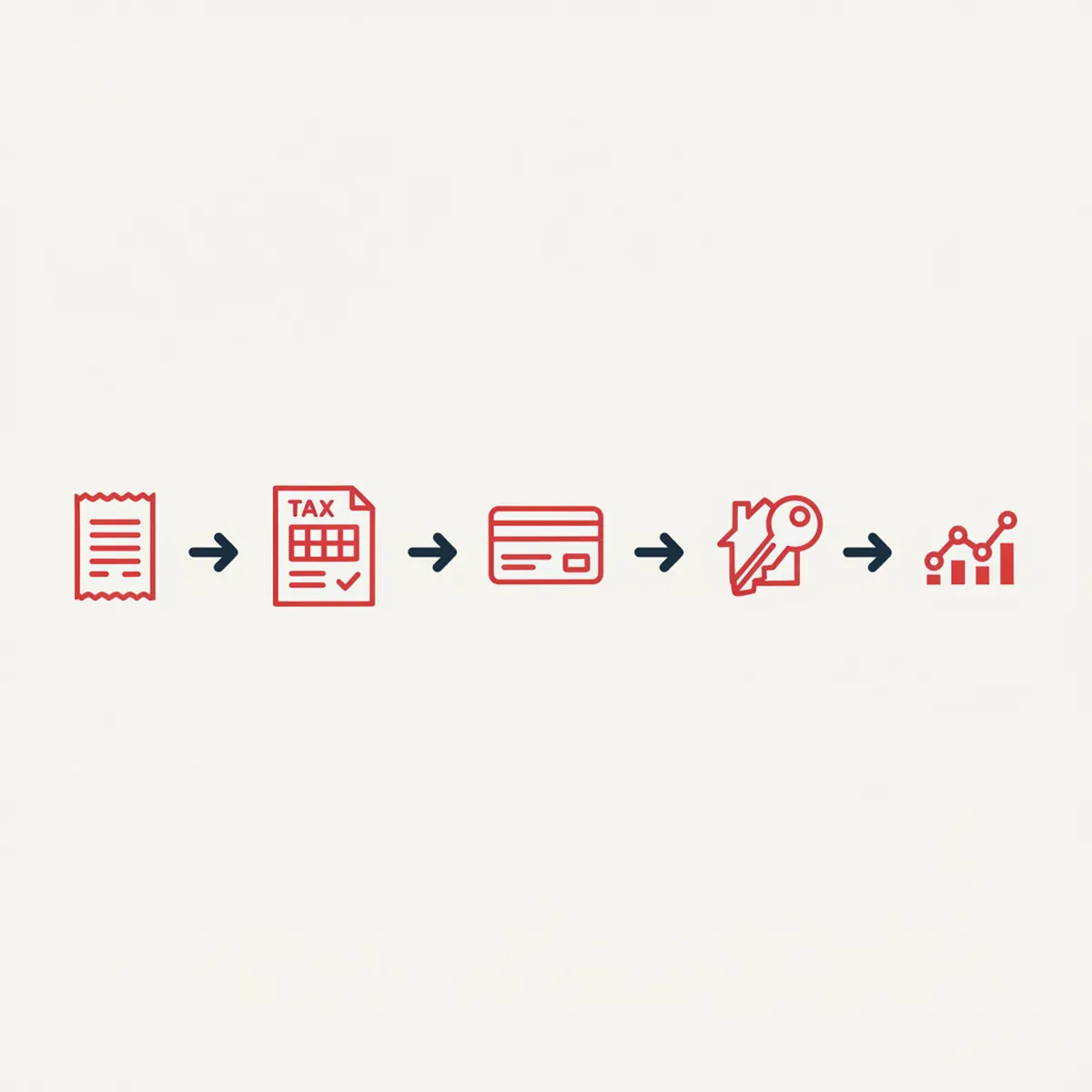
Sort money in the order it arrives. Get the tax card before your first payday, or your employer withholds 55%. Then open a bank account and register it as NemKonto, because public money — a tax refund, your holiday pay — is paid there. Only after that do the day-to-day costs, insurance, investing and cross-border questions make sense.
Why this page puts money in an order#
Almost every money question a newcomer asks is really two questions: what do I do and when does it have to be done. The second one is where people lose money. Each step below depends on the one before it, so doing them out of order means doing them twice — or paying for the gap.
The dependency chain is short:
- The tax card has to exist before your first payday. Without it your employer must withhold 55% skat.dk1.
- The bank account has to exist before NemKonto means anything, because NemKonto is one of your own accounts registered with the authorities — not an account they give you.
- NemKonto has to work before public money reaches you: a tax refund, holiday pay, anything the state owes you.
- Insurance and the rest of daily life come after you have an address, because a contents policy covers a home.
- Investing and cross-border money come last, because they are questions about money you have already sorted — not about money still on its way to you.
1. Money in: salary, tax card, holiday pay#
Start here, whether you have a job offer already or are still looking.
- How to get a tax card and understand Danish tax — the 55% problem, the form, and how to fix a wrong tax card later.
- What salary to expect in Denmark — the bands by sector, and what is normal to negotiate.
- Holiday pay (feriepenge) — 12.5% of your pay is set aside and paid out when you take holiday borger.dk3. It is your money and nobody reminds you to claim it.
- Jobs you can get without Danish — if the salary is not there yet.
- Unions and a-kasse — the safety net you join while you are employed, not after.
2. Tax: what is taken, and what you can claim back#
- Danish tax rates 2026 — the labour market contribution, the state brackets, the municipal rate and the tax ceiling, with the 2026 numbers.
- The expat tax scheme — 27% plus the labour market contribution for approved researchers and key employees, if you qualify and apply in time.
- Deductions and allowances — the ones you get automatically and the ones you have to enter yourself on your annual assessment skat.dk5.
3. The account everything runs through#
- Opening a Danish bank account as a foreigner — what banks ask for, why they refuse, and the basic payment account you have a right to as an EU/EEA resident: the bank must decide within 10 working days Finanstilsynet2.
- MobilePay, Revolut and Wise — how to pay for things in the weeks between landing and having a Danish account, and what MobilePay actually requires.
4. Day to day: what living here costs#
- What it costs to live in Copenhagen — rent, deposit, childcare and the monthly total, with the numbers behind them.
- Insurance — what is mandatory, what is worth having, and what you can skip.
- Credit cards — what the cards cost per year, and why cashback here is thin.
- Phone plans and SIM cards — prepaid without a CPR number, and the intro price that doubles after six months.
- Supermarkets and online shopping — where the everyday money actually goes.
5. Money that does not stay in Denmark#
- Investment tax — Aktiesparekonto at 17% a year on the change in value with a DKK 174,200 ceiling for 2026, ordinary accounts on the share-income brackets, and the annual mark-to-market that catches foreign shares and most ETFs skat.dk4.
- A tax residency certificate — the document a foreign bank, employer or tax authority asks for when it wants Denmark to confirm where you live and that you are taxed here: form 02.034A where a treaty exists, 90 days’ stated processing.
- Foreign assets and bringing your money to Denmark — worldwide tax liability from the day you move, double taxation agreements, and what you must declare at the border.
What this page is not#
It is not financial advice, and it does not rank banks, brokers or cards. We describe how the rules and the costs are structured and link the authority that sets each one, so you can check the position that applies to you. Where a number has a year attached, it is that year’s number — these change annually.
Next steps on this site#
- The arrival order — the same dependency logic applied to paperwork: CPR, MitID, bank, tax card, doctor.
- All the guides — every topic, grouped.
- Daily news in English — including the tax and rule changes that move these numbers.
Frequently asked
What order should I sort out money in when I move to Denmark?#
Tax card first, because it has to exist before your first payday. Then a bank account registered as your NemKonto, because that is where public money is paid. Then the day-to-day costs — insurance, phone, card — and last the longer-term questions: investing, foreign assets and double taxation. The order is driven by dependencies, not by importance: each step needs the one before it.
What happens if I start work before I have a tax card?#
Your employer must withhold 55% of your pay until a tax card exists. It is not a fine and you are not in trouble: the money is settled on your annual tax assessment, but you have lent it to the tax office interest-free for months. The tax card is free and is normally generated immediately at skat.dk/tastselv once you have a CPR number.
Can I open a Danish bank account before I have a CPR number?#
For an ordinary account, in practice no: banks verify identity, address and often work. But as an EU/EEA resident you have a legal right to a basic payment account (basal betalingskonto), and the bank must decide within 10 working days of a complete application. It can be used as your NemKonto.
Do I need a NemKonto?#
Yes, if you expect money from Danish public authorities — a tax refund, holiday pay, benefits, a pension. NemKonto is not a separate account: it is one of your own accounts registered with the authorities so payments can be made to it.
When do I need to think about investment tax?#
Once you are tax resident and have money you are not spending. The trap is that Denmark taxes the same investment differently depending on the container it sits in: an Aktiesparekonto is taxed at 17% a year on the change in value, with a deposit ceiling of DKK 174,200 for 2026, while an ordinary account follows the share-income brackets. Most foreign ETFs are taxed every year even if you never sell.
Official sources
- skat.dk - Get a tax card as a non-Danish employee skat.dk
- Finanstilsynet - Banks and the basic payment account finanstilsynet.dk
- borger.dk - Holiday for employees (feriepenge) borger.dk
- skat.dk - Aktiesparekonto (rate and deposit ceiling) skat.dk
- skat.dk - Deductions and allowances for individuals skat.dk
- Life in Denmark - When you arrive lifeindenmark.borger.dk
Links checked when this guide was last updated (26 October 2026). Rules change — if a link fails, tell us and we'll fix it.